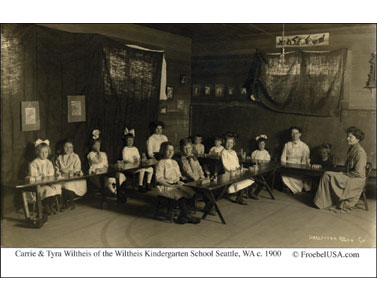

Happy 230th Birthday Friedrich Froebel
On this day 230 years ago, Friedrich Wilhelm August Fröbel was born in Oberweisbach, Germany. As a child he spent a great deal of time playing alone in the woods behind his home and later he spent his teen years apprenticed to a forester, cataloging and surveying the Thuringian forests of south-eastern Germany.
He attended the University of Jena, studying natural sciences and assisting Prof. Christian Samuel Weiss with cataloging minerals by their geometry (which lead to the development of crystallography). After a stint in the army fighting Napoleon’s army, Froebel began work with the great educator Pestalozzi, teaching middle-school children. It was there that he began to develop his theories of education, in conjunction with his interest in philosophy, mineralogy, forestry and geometry. He called this idea “Kindergarten,” the concept that children can be developed to reach their potential with the care of parents and teachers in a carefully prepared environment.
All of his early experiences prepared Froebel to make a huge leap in understanding, which forever altered the way the entire world views childhood and education. Froebel’s worldwide legacy is vast, reaching across the math, science, philosophy, psychology, education and the arts. Here are just a few of the great ideas introduced and nurtured by Froebel and his Kindergarten movement:
Froebel deduced that brain development is most pronounced between birth and age 3.
Froebel taught that children develop at different rates, so Kindergarten was an ungraded range from ages 3-7. It was a multi-age setting and combined boys and girls, and children of both rich and poor into a community of education that involved both parents and teachers.
Froebel recognized that humans are creative beings and must be taught about creating through observation of nature and through a process of creative activities. As such, the Froebel Gifts & Occupations were the world’s first toys designed specifically for child development.
Froebel invented play-based education and the concept of the prepared environment.
Froebel pioneered holistic education.
Froebel invented both child-centered and whole-child approaches to education, urging educators to “follow the child.”.
Froebel developed the morning circle and engaged children in decision-making and news of the day.
Froebel pioneered the use music, movement, games and craft activities (including geometric paper-folding) in an educational setting, including the use of finger plays with children.
Froebel taught children a visual language using basic geometric shapes and building blocks, including point, line, plane and solids … which later influenced students of his method to develop the Bauhaus school of design.
Froebel believed that the capacity of women to give birth gave them a special ability for educating young children. He employed women in his schools and the Kindergarten became one of the first accepted occupations for women outside the home, allowing more women to obtain advanced education and establish careers. The educational, social and financial work of Kindergartners empowered American women to organize for the right to vote and a larger voice in community affairs.
2012 Froebel USA International Education Conference
This year’s Froebel USA conference will be held August 4-5, 2012 in San Francisco. Attendees from Asia, Europe and North America will convene to share practical techniques for using the Froebel Gifts & Occupations in a modern educational setting. A diverse interdisciplinary group, including early childhood educators, homeschooling parents, designers, and architects will be present. Over 12 speakers will present mostly hands-on activities for applying the Froebel materials to design education, literacy assessment, teaching geometry and much more. For more information please visit the Froebel USA conference website or the online registration form.
The Challenge of Froebel Teacher Training
A recent article by Barbara Beatty, professor of education at Wellesley College, highlights the challenges faced in training Froebel teachers a hundred years ago and the implications for training today’s early childhood teachers. Barbara Beatty’s history of early childhood, Preschool Education in America: The Culture of Young Children from the Colonial Era to the Present is the best in-print document for why the Froebel system was rejected in the early 1900′s. It is a balanced and well researched look at the factions and issues of the time. If you can find it, the long out-of-print book by Michael Shapiro, Child’s Garden, provides another detailed account, focusing just on the Froebel Kindergarten.
Beatty’s recent article looks at the contrast between scripted and unscripted instruction. Another thoughtful and well documented work, it casts a modern eye on the heavy-handed way Froebel teachers were drilled at the end of the Froebel era. While it does not address it specifically, it raises an important issue about the difference between a teacher’s own training and their classroom actions. Often the Froebel teachers received set instructions for their behavior while allowing children to respond creatively to the activity at hand. Froebel Kindergarten teachers were expected to respond appropriately to whatever occurred in the moment. They were highly trained, think “Navy Seals” or “Jedi Knights” of the classroom and. once trained, were usually given free reign by their employers or supervisors.
However, the instruction was rigorous and tedious, and not all teaching students were suited for the work. Coupled with the exponential growth in demand for Kindergarten, it became impossible logistically to meet both the quantity and quality goals. So the leadership of the Columbia Teachers College (William Heard Kilpatrick, Patty Smith Hill, et al) and John Dewey, of the University of Chicago, staged a coup and took early childhood education off a Froebel standard into a more “Progressive” (although factory-like) model of education.
It is possible that much of our decline in education can be traced back to this practical/philosophical shift. As the pendulum swings back toward play-based, child-centered education with a goal toward developing creative, life-long learners, we may discover that we’ve held ourselves back for an entire century.
A Role for Women in the Froebel Kindergarten
One of the great contributions of the Froebel Kindergarten was offering perhaps the first significant career for women outside the home (just as nursing was also getting started). In the mid 19th century, women were not expected (or even widely allowed) to work professionally. This meant a life of domestic work tethered to men (fathers, husbands, brothers) or the church. The Kindergarten attracted many ambitious, intelligent women and allowed them to become self-supporting (and often business owners themselves) while providing perhaps the highest human calling — the education of the human race. Many famous women were involved in Froebel’s cause; Baroness Bertha von Marenholz Bulow, Helen Keller, Kate Douglas Wiggin, Elizabeth Peabody, Anna Bissell, Phoebe Hearst, Mrs. Leland Stanford, Mrs. Grover Cleveland, Margaret Hamilton, Elizabeth Harrison (… the list is a long one and I’ll let you Google those listed for more info). Read More…